 Get it for my Mac (447 MB)
 Arturia Efx AMBIENT
1.0.0
- Version
- 1.9.2 (5305)
- Developer
- Arturia
- Interface in
- English
- Licence on file
- Included
- macOS it runs on
- macOS 11 or later
- Chip support
- Apple Silicon, Intel 64-bit
In the edit
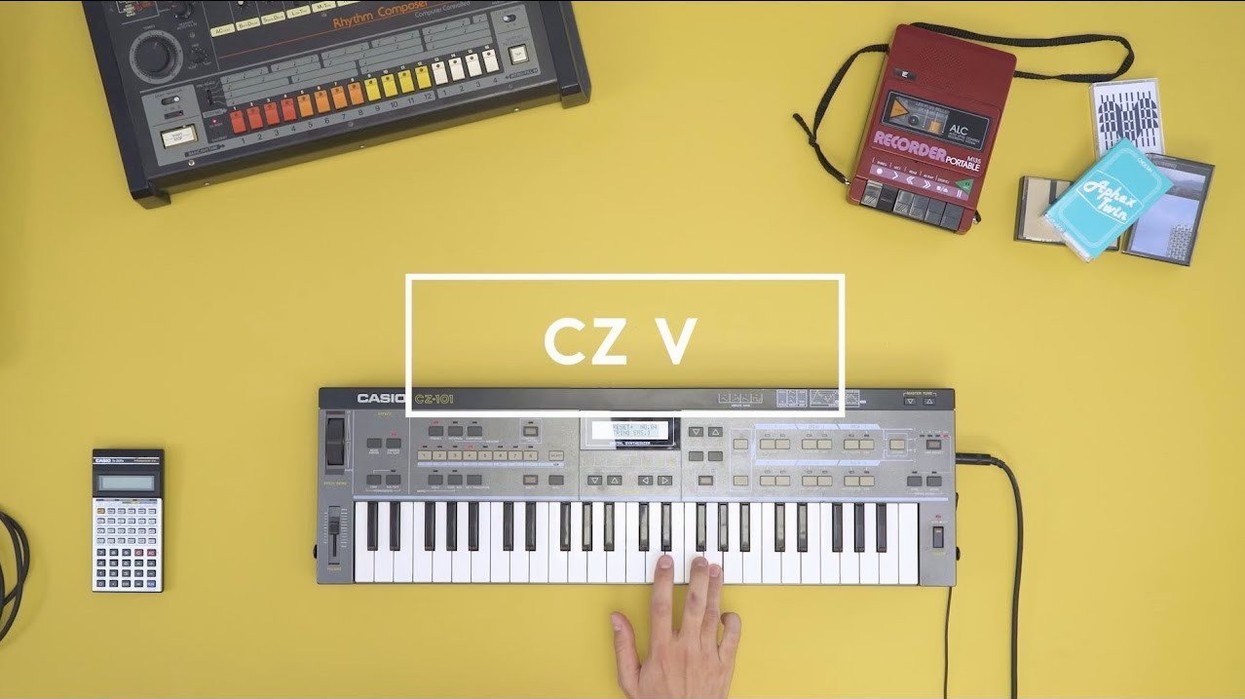
Load Arturia CZ V on a track when you need the distinct digital crunch of an 80s Casio but want modern control. It models the phase distortion engine from the CZ-1 and CZ-101, letting you sculpt sounds that sit between analogue warmth and cold digital texture.
Phase Distortion and DCW give glassy metallic attacks
Phase Distortion — Select a waveform and modulate the timing of a simple carrier wave at the cycle level. This is what gives you those metallic, glassy, or percussive attacks that don’t sound like subtractive synthesis.
DCW (Digital Controlled Waveform) — Shapes the harmonic content after the phase distortion stage. Turning it up adds bite or bloom, depending on the waveform you chose.
Envelope Generator — Eight-stage envelopes per voice. You can programme slow, evolving pads or tight, snappy percussion without the limitations of older hardware.
Chorus / Delay — Built-in effects that spread the stereo image or add space. Useful for turning a dry phase-distortion patch into a bed of sound without extra plugins.
Two quick tweaks to make the default patch your own
When you first open CZ V, the default patch is usually a solid starting point, but a couple of quick tweaks will make it feel like your instrument rather than a museum piece. Head to the main settings panel and turn up the voice count — the original hardware was limited to eight voices, and while the emulation respects that character, you can push it higher for dense chords that don't choke. Set it to sixteen or twenty-four if you're stacking layers.
The tuning section is worth a look straight away. The CZ series had a distinctive pitch bend range that some players find narrow. Open the pitch bend parameters and widen the range to plus or minus five semitones if you want expressive slides. Keep it at two if you prefer the original feel.
Switch the velocity curve to match your keyboard. The default curve works for general playing, but if you find the softer hits are too quiet or the loudest hits clip the filter, pick one of the alternative curves from the utility menu. I tend to use the logarithmic option for weighted keys and the linear one for synth action boards.
Lastly, enable legato mode in the mono settings. This lets you play phrases where the second note doesn't retrigger the envelope, which makes bass lines and lead parts sound more connected. The original Casio didn't do this, so it's one of the modern additions that actually improves playability.
Fix silent presets by checking volume fader and filter
No sound on some presets — A handful of factory patches have the volume fader set very low or the filter closed entirely. Check the main output level in the top bar first, then look at the amp envelope. If the sustain level is at zero, raise it until the note holds. This catches out a lot of people on first load.
Phase distortion sounds too harsh — The raw waveforms can be piercing, especially through bright monitors. You keep the character without the ear fatigue.
Plug-in doesn't appear in the host — After installing, the VST or AU versions might not register if your DAW scans a custom folder. Run the Arturia Software Center and confirm that CZ V is activated, then rescan plugins from your DAW's preferences. If it still doesn't show, restart the computer — the installer sometimes needs a clean reboot to finish linking the components.
Standalone app won't open — This usually happens when the audio device isn't selected correctly. Open the audio settings from the standalone menu and choose your interface or built-in output manually. The auto-detect doesn't always pick the right driver on the first try.
Building a moving pad from a chord progression in CZ V
I start a track with a simple chord progression in mind, something that needs a pad with movement but not the washed-out sound of a Juno emulation. I load CZ V as a VST instrument on a midi track and scroll through the factory presets until I land on one called Digital Strings. It has that hollow, phase-shifted body that sits behind a vocal without fighting for space.
The patch is close but too static. I open the DCW section and route an LFO to the cutoff at a slow rate, about a quarter-note cycle. The waveform starts breathing gently. Then I go into the eight-stage envelope and pull the decay of the second stage down slightly so the initial attack has a tiny spike before it settles. That little transient makes the pad feel played rather than held.
I record a four-bar loop of major seventh chords and listen back. The low end is a bit thin, so I duplicate the midi track, transpose the second instance down an octave, and change its patch to a bass preset called Low Brass. I nudge the phase distortion amount on that bass patch until the fundamental punches through without rattling the subs.
For the bridge section, I want a metallic, percussive hit that cuts through the mix. I pick a fresh init patch and draw a sharp envelope with a fast attack, short decay, and zero sustain. One note on the offbeat, every two bars. It sounds like a bell being struck with a metal rod — exactly the texture I could not get from a standard subtractive synth.
By the end of the session, I have three CZ V tracks: a breathing pad, a transposed bass layer, and a percussive accent. None of them sound like an FM synth, but they also don't sound like analogue. That's the point of phase distortion — it sits in its own territory, and once you know which settings to touch first, you can dial it in quickly without fighting the interface.
Mac it needs
- macOS 11 or later
- Apple Silicon or Intel 64-bit processor
Questions I actually get
What Macs does Arturia CZ V run on?
It supports Apple Silicon and Intel 64-bit Macs running macOS 11 or later.
What plugin formats are included?
The plugin runs as VST 2.4, Audio Units, and AAX, so it works in most major DAWs.
Is this an exact copy of the original Casio CZ-1?
It is a software reimagining that models the phase distortion engine, but adds modern controls like eight-stage envelopes and built-in effects.
Installing on a Mac
- Open the downloaded package and follow the installation instructions included inside.
- Activate the plugin using the activation steps provided in the same package. That is all.
Notes from photographers
Sign in or create your account to leave a comment.
No notes from photographers yet. If you have used this on a real folder, say which camera and which Mac.