 Get it for my Mac (4.4 GB)
 uJAM Cinedream
1.0.1

- Version
- 1.3.1
- Developer
- uJAM Instruments
- Interface in
- English
- Licence on file
- K'ed by MORiA
- macOS it runs on
- macOS 10.14 or later
- Chip support
- Apple Silicon, Intel 64-bit
In the edit
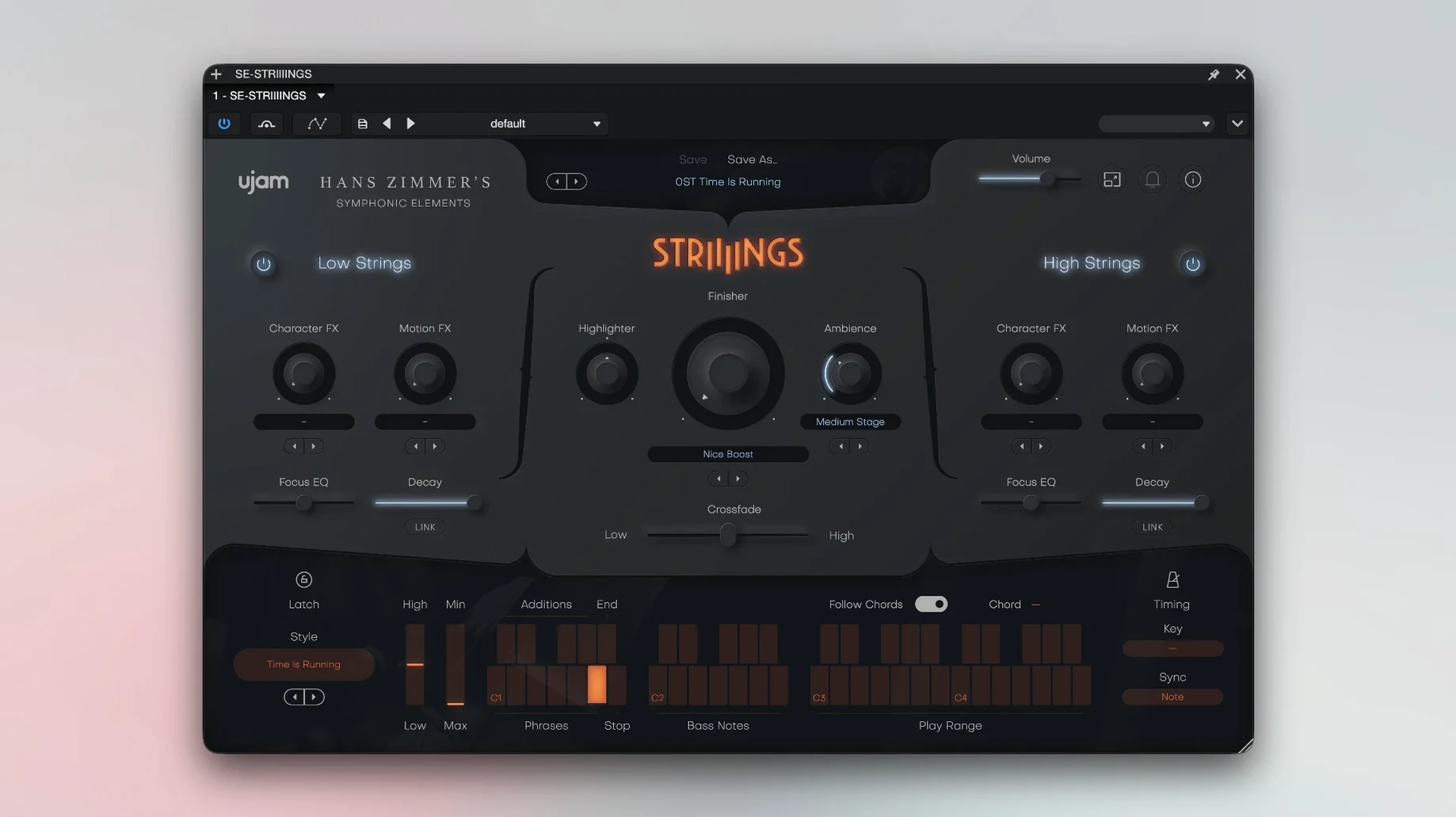
You are scoring a scene that needs weight — low-end tension from basses and celli, then a viola line that lifts without turning saccharine. UJAM Symphonic Elements STRIIIINGS gives you both layers independently, so you can ride the Low Strings (basses and celli) against the High Strings (violins and violas) without reaching for a separate mixer track. Each section has its own set of controls, which means you can darken the low end while keeping the high strings airy, or push the whole thing into a processed, almost synth-like zone using the built-in sound-design element.
What the controls let you do
- Adjust Low Strings and High Strings independently — blend, mute or solo each layer as the cue demands
- Reach for the sound-design controls when you need something less orchestral and more textural
- Work with modern string-ensemble samples that sit well in a dense mix without extra EQ
Built for contemporary strings that can take abuse
As the first title in UJAM’s Symphonic Elements series, STRIIIINGS is built for composers who want a string section that sounds contemporary and can take a bit of abuse — the sound-design side lets you warp the samples into pads, drones or grit. It runs on macOS 10.14 through Tahoe 26, supports Apple Silicon and Intel, and asks for 4 GB RAM. Open it twice the first time to authorise, then it behaves like any other plugin.
A session with STRIIIINGS, start to finish
I had a brief for a short film cue — a slow reveal, something uneasy but not scary. I opened STRIIIINGS in Logic, chose a blank preset, and started with just the Low Strings. The basses and celli have a natural weight that doesn't need much tweaking, so I left the character knob where it was and played a simple two-note pattern. It sat well immediately, no extra EQ needed.
Next, I brought in the High Strings. Violins and violas can get piercing fast, so I pulled the level back and set the Crossfade control to about 70 percent low, 30 percent high. That gave me the body from the lower register and just a hint of movement from the top end. I played a slow melody line — nothing busy, just a few held notes — and the two layers locked together without me touching a mixer channel.
The cue needed a build, so I automated the Crossfade control over sixteen bars, letting the High Strings creep up until they matched the Low Strings. Then I added one of the sound-designer presets underneath — a deep, evolving pad that sat behind the strings and thickened the atmosphere without clashing. The whole thing came together in about twenty minutes, and I didn't open a single other plugin.
Small details that make a difference
Some features are easy to overlook until you need them. The fact that STRIIIINGS splits the orchestra into Low and High strings is obvious enough, but the independence of each layer goes beyond volume: you can adjust the character and presence of each section separately. That means you could have a gritty, processed low end and a clean, natural high end in the same patch, which is useful for hybrid scores.
The Crossfade control is a single slider, but it changes the whole feel of the arrangement. Push it one way and you get a bass-heavy, cinematic rumble; push it the other and the violins take over. It is not a blend knob — it shifts the emphasis in a way that feels musical, not like a simple volume fade.
Another small convenience: the 60 styles and more than 200 presets are organised in a way that makes sense for quick browsing. You can scroll through by mood or by texture, and each preset keeps the Low/High balance intact, so you can tweak without starting from scratch. The presets also include the sound-design treatments, which saves time when you want something that sits between orchestral and electronic.
Creating an evolving pad for a dialogue scene
For a recent game soundtrack project, I needed a sustained, evolving pad that could sit under a dialogue scene. I started a new instance of STRIIIINGS, set both sections to a neutral starting point, and played a long, slow chord with the Low Strings. The sustain is natural — no looping artefacts, just a steady decay that felt organic.
I then added the High Strings playing the same chord an octave higher, but I kept their level low enough that they added shimmer rather than volume. Using the Crossfade control, I settled on a blend that let the basses carry the weight while the violins added a soft, almost vocal quality. Then I brought in a sound-design preset from the library — something labelled 'texture drone' — and layered it underneath. The combination gave me a pad that evolved slowly, with the strings providing the harmonic foundation and the sound-design element adding movement.
The final step was to record a single pass of the chord progression, then automate the Crossfade and the sound-design level over four minutes. The result was a pad that shifted from dark and grounded to bright and airy without any abrupt changes. No extra plugins, no sidechain compression, no reverb sends — just STRIIIINGS doing what it does.
Mac it needs
- macOS 10.14 or later (up to macOS Tahoe 26)
- Apple Silicon or Intel processor
- 64-bit software only
- 4 GB RAM
- Interface language: English
Questions I actually get
Can I adjust the low and high strings separately?
Yes. STRIIIINGS splits the orchestra into Low Strings (basses and celli) and High Strings (violins and violas), and each section can be adjusted independently.
Installing on a Mac
- Installation and activation instructions are included in the package.
- Open the plug-in twice the first time you launch it.
Notes from photographers
Sign in or create your account to leave a comment.
No notes from photographers yet. If you have used this on a real folder, say which camera and which Mac.