
 Get it for my Mac (38 MB)




 Canopy
2

- Version
- 7.1.6
- Developer
- Bombich Software
- Interface in
- English
- Licence on file
- Included
- macOS it runs on
- macOS 10.15 or later
- Chip support
- Apple Silicon, Intel 64-bit
In the edit
You have a shoot folder spread across two external drives, a bootable clone that saved you once before, and a schedule that runs while you sleep. Carbon Copy Cloner 7 is the tool that makes that setup stick. It creates bootable clones of your startup disk, lets you choose exactly which destination disk receives the backup, and schedules the whole thing automatically. For anyone who has rebuilt a system from a clone, that peace of mind is worth the few minutes it takes to set up.
- Bootable clones: a direct copy of your startup disk that can boot your Mac if the original fails.
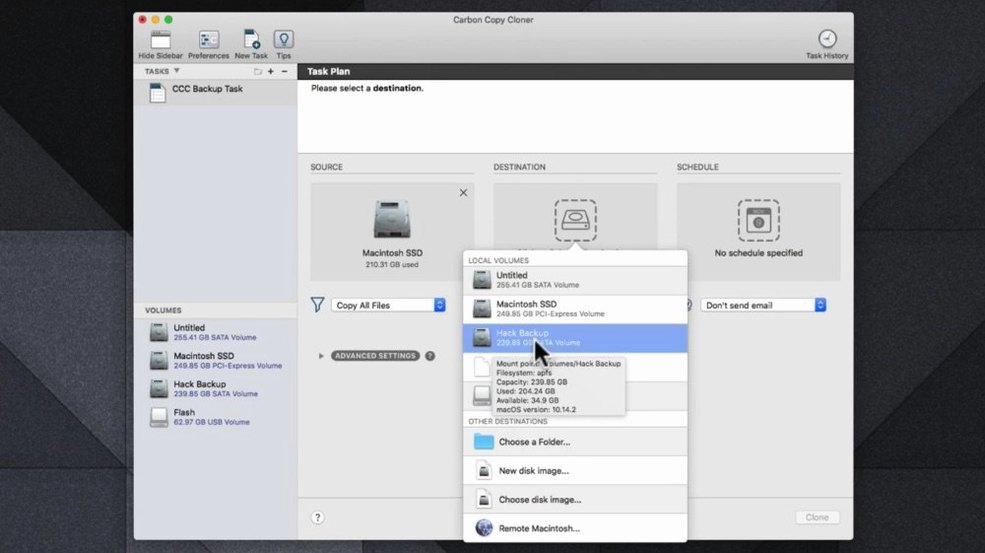
- Destination disk selection: pick any connected volume, internal or external, for each task.
- Automatic scheduling: run backups hourly, daily, weekly, or on a custom timetable.
- Native on Intel and Apple Silicon: CCC 7 runs as a universal binary, no translation layer needed.
- Fully qualified on macOS Golden Gate: tested against the latest OS version at release.
These are the features that matter when your working drives hold months of edits and your next wedding is Saturday. Carbon Copy Cloner 7 does not overcomplicate the process — it just makes sure the clone is there when you need it.
Start with one backup task for your startup disk
Once Carbon Copy Cloner 7 is on your Mac, resist the urge to set up a dozen tasks at once. Start with one backup task for your startup disk. Choose an external drive as the destination — something large enough to hold everything, ideally an SSD if you want the clone to be bootable. Run the task once manually to confirm it completes without errors. That first successful clone tells you the basics are working: permissions, disk format, cable connection.
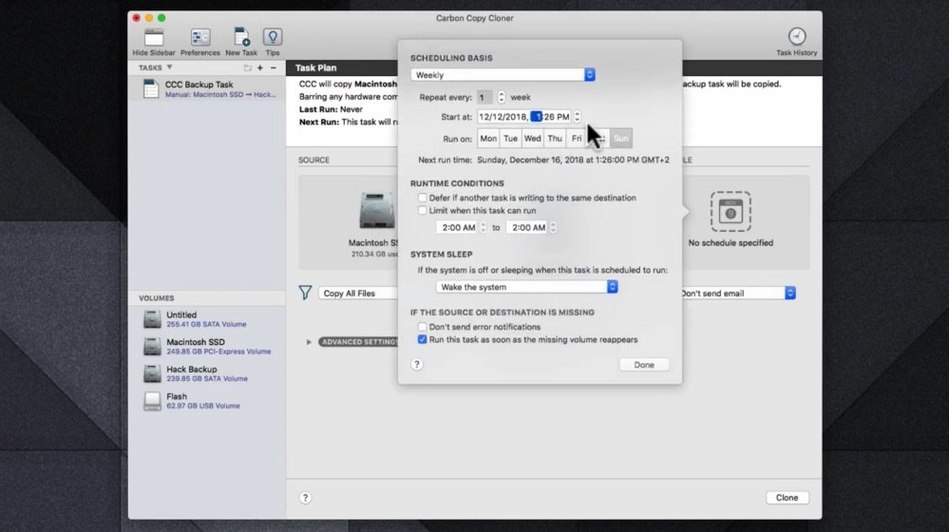
Next, schedule that same task. Pick a day and time when your Mac is plugged in and awake. For a working photographer, Sunday night at 2am works well — the week's edits are done, the drives are still connected, and nothing is being written during the backup. Let CCC run that schedule for a few days before you add more tasks. A single reliable backup is better than five that fail silently.
Keep an eye on the task log after the first few runs. Carbon Copy Cloner reports what it copied, what it skipped, and why. If you see repeated warnings about a particular file or volume, deal with it early. Small issues grow into missed backups over time.
Photographers and videographers with large project files
Carbon Copy Cloner suits anyone who treats their Mac as a working tool rather than a consumption device. Photographers and videographers are the obvious group — the one I write for — because our project files are large, our deadlines are tight, and a dead drive on a Saturday morning means more than lost data, it means lost income. A bootable clone gets you back to shooting or editing within minutes, not hours.
System administrators and IT support people also benefit heavily. CCC's scheduling and destination flexibility let them push consistent backups across multiple machines without scripting their own solution. A weekly clone of a server or a shared workstation, written to a dedicated volume, keeps recovery times predictable.
Anyone migrating data between Macs will find CCC useful too. Point it at the old machine's drive, pick a destination on the new one, and let it copy everything — applications, settings, files — in one pass. No dragging folders, no forgotten preferences, no re-downloading software. The clone approach respects the original structure, which saves the sort of fiddling that wastes an afternoon.
Casual users who back up once a year can also get value, but the real return comes when you rely on your Mac daily and cannot afford downtime. If your workflow includes deadlines, clients, or deliverables, CCC is built for you.
More granular control than SuperDuper's stripped-down interface
SuperDuper is the closest competitor. Both create bootable clones and support scheduling. SuperDuper's interface is slightly more stripped down, which some people prefer. CCC offers more granular control over what gets copied and when, and its task logs are more detailed. Both work well; the choice often comes down to whether you want simpler setup or more visibility into what the backup is doing.
It backs up incrementally and lets you restore files from any point in time. But Time Machine does not produce a bootable clone. If your startup disk fails, you cannot boot from a Time Machine backup directly — you need to reinstall macOS first and then restore. CCC's bootable clone boots your Mac immediately. For photographers who need to keep shooting, that difference matters.
ChronoSync is another option, aimed at users who need two-way synchronisation between folders and volumes alongside backup. ChronoSync is more complex and more powerful for syncing workflows, but CCC is simpler when your goal is a straightforward clone that you can trust to work. I have used ChronoSync for specific folder sync tasks and CCC for whole-disk backup, and each has its place. For most people who just want a reliable clone, CCC is the cleaner choice.
Runs natively on Intel and Apple Silicon Macs
Carbon Copy Cloner 7 requires macOS 10.15 Catalina or newer. It runs natively on both Intel and Apple Silicon Macs thanks to a universal binary — no Rosetta translation, no performance overhead. The installer is a standard Mac application bundle, a few megabytes in size. Activation instructions are included with the download, and the process takes under a minute.
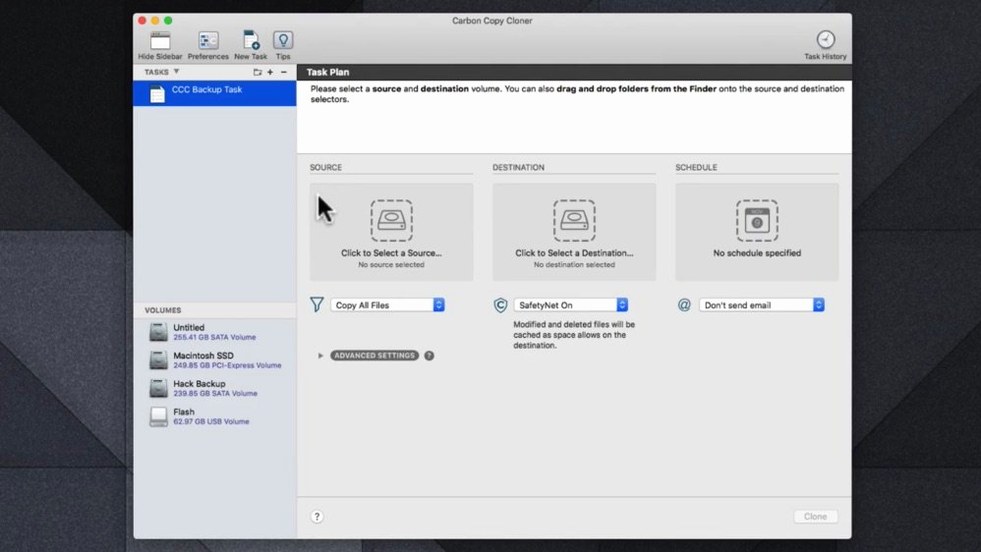
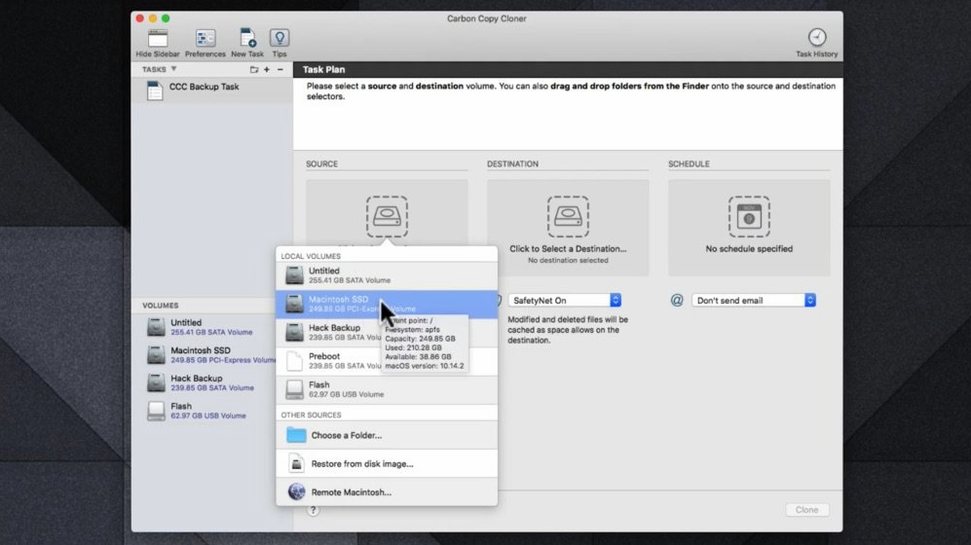
The interface is a single window with a task list on the left and configuration panels on the right. No hidden menus, no daemons running in the background without your knowledge. When a task runs, you see progress, file count, and any warnings in real time. The app respects your Mac's power management: scheduled tasks only run when the machine is awake and the drive is connected.
CCC does not modify your system files or inject kernel extensions. It works at the file level, reading and writing like any other application. The clone it produces is an exact copy of your source volume, down to the file permissions and metadata, but the app itself stays out of the way when it is not actively backing up.
Set the schedule to a specific day and time
Open Carbon Copy Cloner and look at the default task settings. The first thing to adjust is the schedule. The default may not suit your rhythm. Set it to run on a specific day at a specific time — weekly is enough for most photographers, nightly if you are in the middle of a heavy edit week. Pick a time when you know the Mac will be on and the destination drive connected.
Review the source selection. By default, CCC backs up the entire volume. If your startup disk holds only the system and applications, and your working files live on an external drive, consider creating a separate task for that external drive. That way you can schedule the system clone weekly and the working drive clone daily, or even hourly during a project.
Check the safety net settings. CCC can be configured to retain older versions of changed or deleted files for a set number of days. This is useful if you accidentally overwrite a file and do not notice until the next backup has already replaced it. A retention period of seven days is a good starting point — long enough to catch mistakes, short enough to avoid filling the destination disk with old data.
Finally, enable notifications. Carbon Copy Cloner can send a notification when a task completes, when it encounters an error, or when the destination disk is nearly full. On a busy shoot day, you might not check the app window. A notification tells you the backup finished before you disconnect the drive and walk out the door.
Mac it needs
- macOS 10.15 Catalina or later
- Intel or Apple Silicon Mac
Questions I actually get
Can Carbon Copy Cloner create a bootable backup of my Mac?
Yes. CCC 7 can create a bootable clone of your startup disk on a destination drive, which can be used to start up your Mac if the original drive fails.
Installing on a Mac
- Download the disk image and open it.
- Drag the Carbon Copy Cloner app into your Applications folder.
- Open the app and follow the on-screen instructions to activate your licence.
- Your activation key is included with the download — enter it when prompted.
Notes from photographers
Sign in or create your account to leave a comment.
No notes from photographers yet. If you have used this on a real folder, say which camera and which Mac.
