 Get it for my Mac (24 MB)
 EZdrummer
3.1.2
- Version
- 1.9.7
- Developer
- FKFX audio
- Interface in
- English
- Licence on file
- K'ed by MORiA
- Chip support
- Apple Silicon, Intel 64-bit
In the edit
The latest version, 1.9.7, keeps the focus on what this plugin does best: shaping sound with movement. Obvious Filter is built for 64-bit ARM and Intel Macs, and its controls are designed for hands-on tweaking rather than menu diving.
What the controls bring to a mix
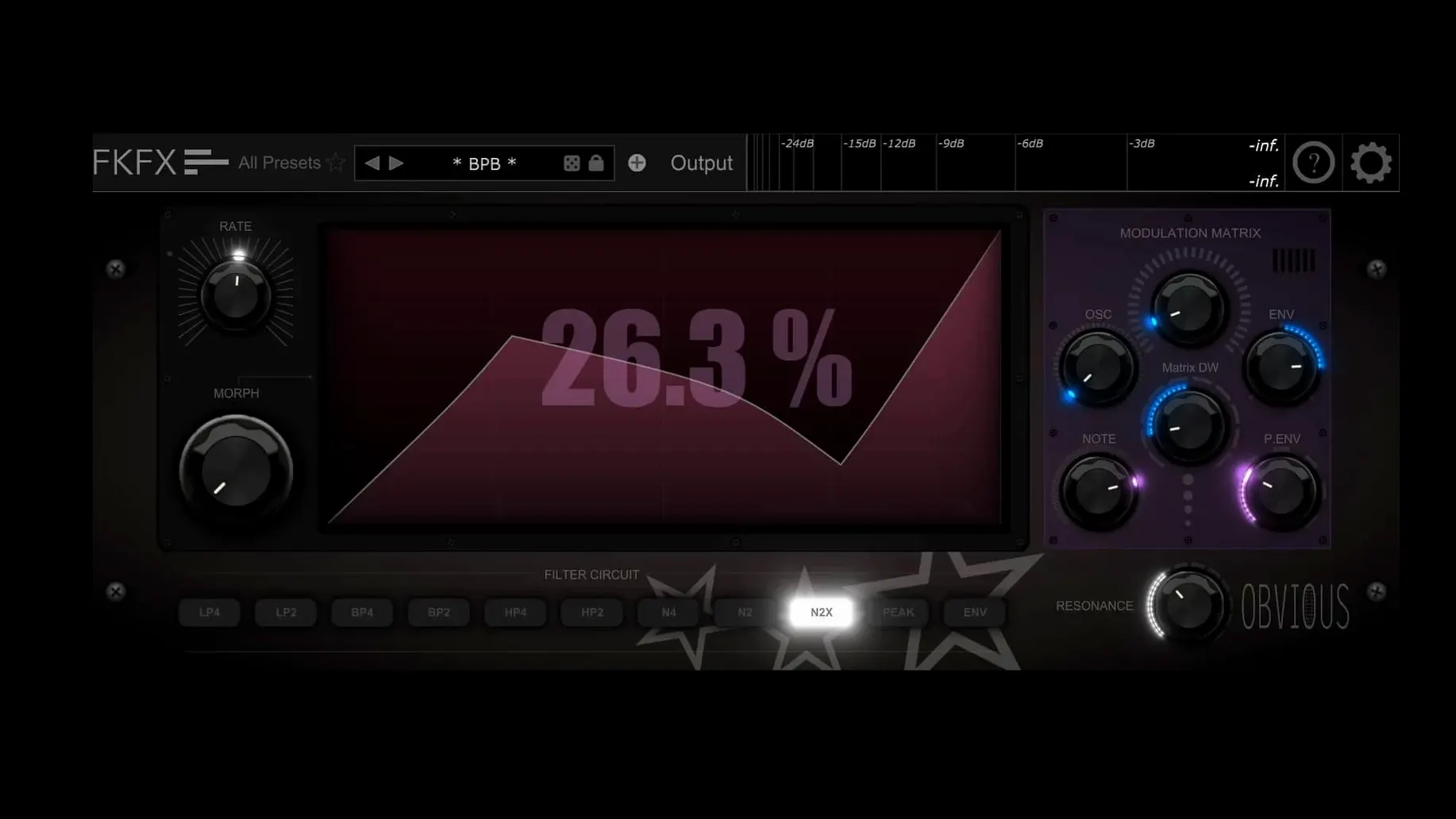
The modulation matrix is the heart of it. You can route LFOs, envelopes and the 39 rare oscillators to almost any parameter, which means filter sweeps can feel organic or aggressive depending on the source. Some of those oscillators are modelled on legendary synths, so the character comes through even before you start drawing modulation paths. The square and line drawing modes let you sketch out filter shapes by hand, which is useful when you want a movement that loops differently each time.
Morphing and LFO depth
Advanced LFO morphing lets you blend between waveforms over time, so a filter can shift from a slow sine to a jagged square across a few bars without automation lanes. It works well on pads, bass lines or anything that benefits from evolving texture. The interface is English, and the plugin runs as a standard VST or AU on both Apple Silicon and Intel architectures.
Pencil drawing tools feel more immediate in 1.9.7
Obvious Filter 1.9.7 didn't introduce a new panel or a redesigned workflow — it tightened what was already there. For anyone who uses the pencil drawing tools regularly, the response feels more immediate when you sketch a filter shape across the grid. The morph editor's multiple functions are easier to reach without digging, which matters when you're building a modulation chain and want to hear the result quickly rather than hunt through sub-menus.
The polyrhythmic rates also benefit from the update. If you set one LFO to a 5/4 rate against a 4/4 beat, the timing locks more cleanly against a project's tempo, so the filter movement doesn't drift over long sections. For sound designers layering multiple modulation sources, that stability keeps the mix from turning muddy on longer pads or evolving drones.
Electronic producers get 39 rare oscillators with built-in colour
Music producers working on electronic or experimental genres will find the most to grab onto here. The 39 rare oscillators give you a starting point that already has colour, so you're not building filter tones from scratch — you pick an oscillator that sounds like an old synth character and let the modulation matrix push it around. Sound designers who layer textures will appreciate the morphing LFO, especially when blending between waveforms over a long decay.
Plugin users who prefer a hands-on approach over preset-scrolling will feel at home. The square and line drawing modes reward people who like to draw their automation rather than click a dropdown. If you run an Apple Silicon Mac, the 64-bit ARM build works natively, and the Intel fallback covers older machines in a studio setup. For anyone who uses the fkfx obvious filter mac free download, the full feature set is available without limitations — the pencil tools, the morph editor, the polyrhythmic rates, everything that makes this plugin more than a standard filter.
Mac it needs
- macOS version not specified by the developer
- Apple Silicon or Intel processor
- 64-bit host DAW
- Interface language: English
Questions I actually get
Does Obvious Filter work on Apple Silicon Macs?
Yes, it is built for 64-bit ARM and Intel Macs, so it runs natively on Apple Silicon and Intel processors.
How many oscillators are included in Obvious Filter?
It includes 39 rare oscillators, some of which emulate legendary synthesizers for added character.
Installing on a Mac
- Extract the downloaded package.
- Copy the plugin file to your VST or AU components folder.
- Open your DAW and rescan plugins to see it.
- Activation instructions are included in the package.
Notes from photographers
Sign in or create your account to leave a comment.
No notes from photographers yet. If you have used this on a real folder, say which camera and which Mac.