
 Get it for my Mac (2.4 GB)
 Microsoft Office
16.93

- Version
- 16.93
- Developer
- Microsoft Corporation
- Interface in
- Russian, English, German, Hungarian, Greek, Danish, Indonesian, Spanish, Italian, Korean, Dutch, Polish, Portuguese, Slovak, Thai, Turkish, Finnish, French, Czech, Swedish, Japanese
- Licence on file
- Volume license
- macOS it runs on
- macOS 13 or later
- Chip support
- Apple Silicon, Intel 64-bit

In the edit
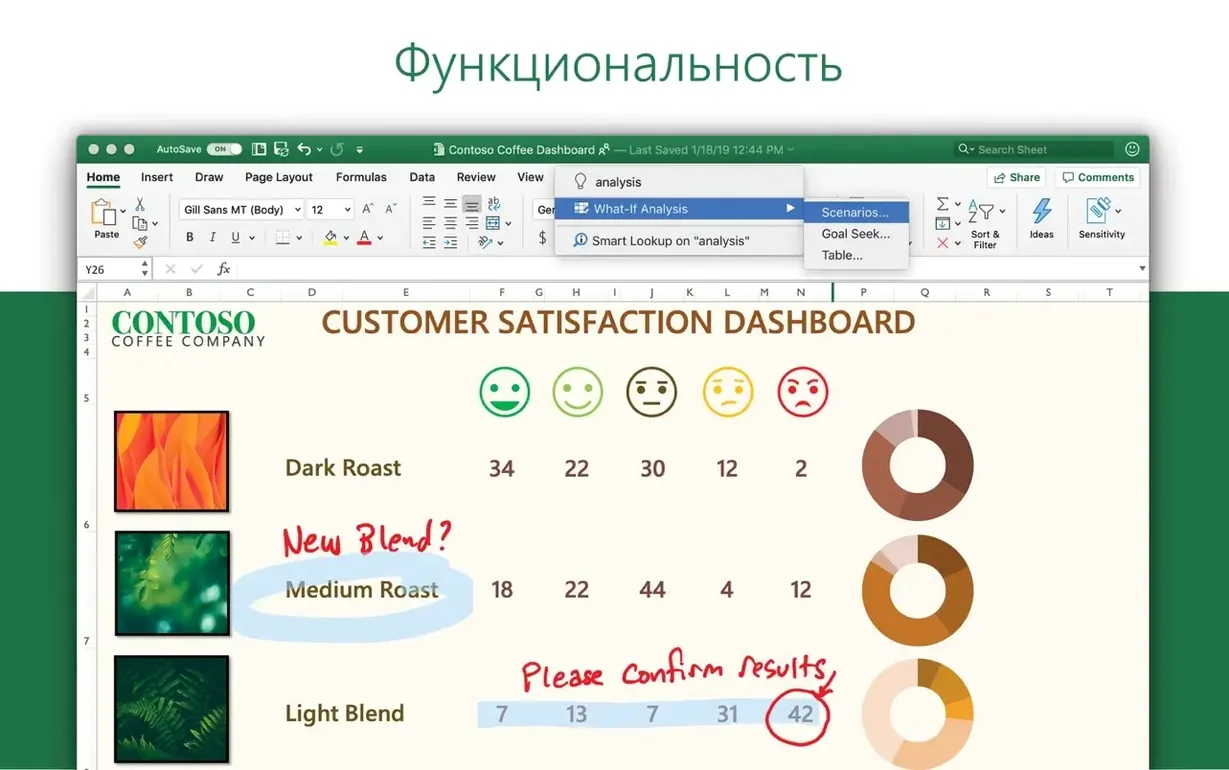
Over a billion rows of data are crunched in Excel every day, and the Mac version keeps pace with version 16.93. The core stays the same: workbooks, formulas, pivot tables, and the familiar grid. What's new are a handful of chart types and the Ideas pane, which suggests trends and visualisations based on your data. The app still requires macOS 13 or later and supports 21 interface languages from Russian to Japanese. It's the same Excel for finance, audit, accounting, and everyday lists, just with a few more ways to see the story in your numbers.
Applying table formats so data behaves properly
Picture a mid-sized audit firm in London. She opens it in Excel 16.93 on her MacBook Pro, and the first thing she does is apply a table format so the data behaves properly when she adds new rows. The Ideas pane catches her eye, and she clicks it out of curiosity. Excel suggests a few summary charts based on the account balances, which saves her the time of building them from scratch for the working papers. She then uses a handful of nested IF statements and a SUMIFS to flag any variances above five percent. The whole process takes about twenty minutes, and the charts end up in the final report without any reformatting. For an auditor, Excel on Mac is still the fastest way to get from raw numbers to a defensible workpaper.
Why Numbers handles simple budgets but Excel wins for heavy data
If you are on a Mac, you have options beyond Excel. Apple Numbers comes free with every Mac and handles simple budgets and personal trackers well. Its interface is cleaner, and its templates look polished out of the box. But Numbers stumbles with large datasets, complex pivot tables, and any file that needs to survive a round-trip to a Windows colleague. Google Sheets is the other big name. It excels at real-time collaboration, and its formula language is close enough to Excel that most people can switch without a manual. But it struggles with files over a few hundred thousand rows, and the offline experience on a Mac feels like an afterthought. Excel 16.93 sits in the middle: heavier than both, but it handles million-row workbooks without a hitch and its pivot table engine is still the gold standard for audit and finance work. If you regularly receive .xlsx files from clients or corporate IT, you will spend less time fixing broken formatting than you would in the alternatives.
Checking your existing formulas and macros after installing
If you have just installed Excel 16.93 on a Mac, here are a few things worth doing early on.
- Open a few of your existing workbooks and check that all formulas evaluate correctly. Complex macros and ActiveX controls from the Windows version may behave differently, so test them before you need them for a deadline.
- Turn on AutoSave in the preferences if you work from a cloud folder. It is off by default in the volume-licensed version, and losing a sheet of work to an unexpected quit is a lesson you only need once.
- Spend ten minutes with the Ideas pane. Click into a few columns of data and see what it suggests. Even if you do not use the charts directly, the trends it spots might point you to a pattern you missed.
- Set your default font and sheet view in the Excel preferences. The default Calibri 11 works for most people, but if you prefer a smaller grid or a different zoom level, change it once and save yourself the clicks later.
How Excel fits into the wider Mac ecosystem
Excel on macOS does not live in a bubble. It works with a few other apps and system features that can make your day easier. If you use Automator, you can build a quick workflow that converts a folder of CSV files into .xlsx workbooks without opening each one. The Finder Quick Look shows a preview of your Excel files without launching the app, which is handy when you are hunting for a specific sheet. And if you use Split View, you can keep Excel on one side and a browser or a notes app on the other. For anyone in finance, the real trick is using Numbers to build a clean summary chart and then exporting it as a PDF for a client, while Excel holds the underlying data. They are different tools, but they complement each other well on the same machine.
Why Windows keyboard shortcuts like Alt don't carry over
Switching from the Windows version or from another spreadsheet app brings a few common stumbles. One of the biggest is assuming that all keyboard shortcuts carry over. Command+C and Command+V work fine, but the Alt key shortcuts from Windows do not exist on Mac. You will need to learn the Command-based equivalents or use the ribbon. Another mistake is ignoring the Power Query tool. It lives under the Data tab and can pull in data from web pages, text files, and databases without you writing a single formula. Beginners often clean data manually when Power Query could do it in two clicks. A third mistake is forgetting that Excel for Mac does not support ActiveX controls or VBA forms the same way Windows does. If your workflow depends on a complex userform from a legacy workbook, test it before you rely on it in a live audit. Finally, many people skip the Ideas pane because they assume it is a gimmick. For small datasets it is not always useful, but for a list of sales figures or account balances, it often surfaces a chart or trend that is worth including in a report.
New this release
- New chart types are included.
- Ideas is included for visualising data and trends.
Mac it needs
- macOS 13 or later
- Intel or Apple Silicon
Questions I actually get
What macOS version does Microsoft Excel 16.93 require?
It requires macOS 13 or later.
Installing on a Mac
- Install Microsoft Office 2024 using the standard installation procedure.
- Alternatively, download the required package using the provided links for Word, Excel, PowerPoint, Outlook, and OneNote.
- Install Microsoft Office LTSC 2024 VL Serializer to activate.
- Install Microsoft AutoUpdate (MAU) to receive future updates.
- After MAU is installed, update Office normally.
- If activation fails, remove Office completely using the linked instructions and reinstall.
Notes from photographers
Sign in or create your account to leave a comment.
No notes from photographers yet. If you have used this on a real folder, say which camera and which Mac.
Similar apps
Next to it in Mac Apps
All Mac Apps picks
Microsoft Office
16.93
 Microsoft Outlook
16.93
 Mimestream
1.10.8
 Mela
2.6.1
 Maschine
3.6.0
 Moneyspire
26.08.3
 MAMP PRO
6.9.0
 MainStage
4.3.1
